A Liquid Handling Workstation can simplify repetitive laboratory procedures, improve pipetting consistency and reduce manual workload. From PCR preparation to ELISA and cell-based assays, automated liquid handling helps researchers manage demanding workflows. However, selecting the right system depends on sample volumes, microplate formats and the complexity of each experiment.
What Can a Liquid Handling Workstation Automate?
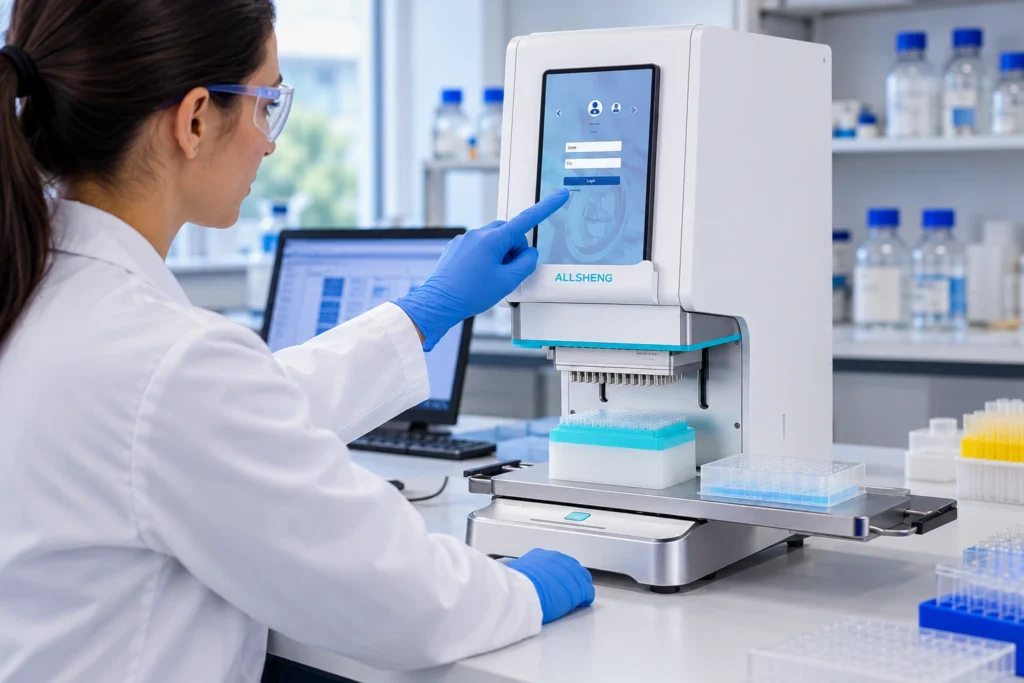
A Liquid Handling Workstation uses programmable pipetting technology to aspirate, dispense, mix and transfer liquids between compatible laboratory containers.
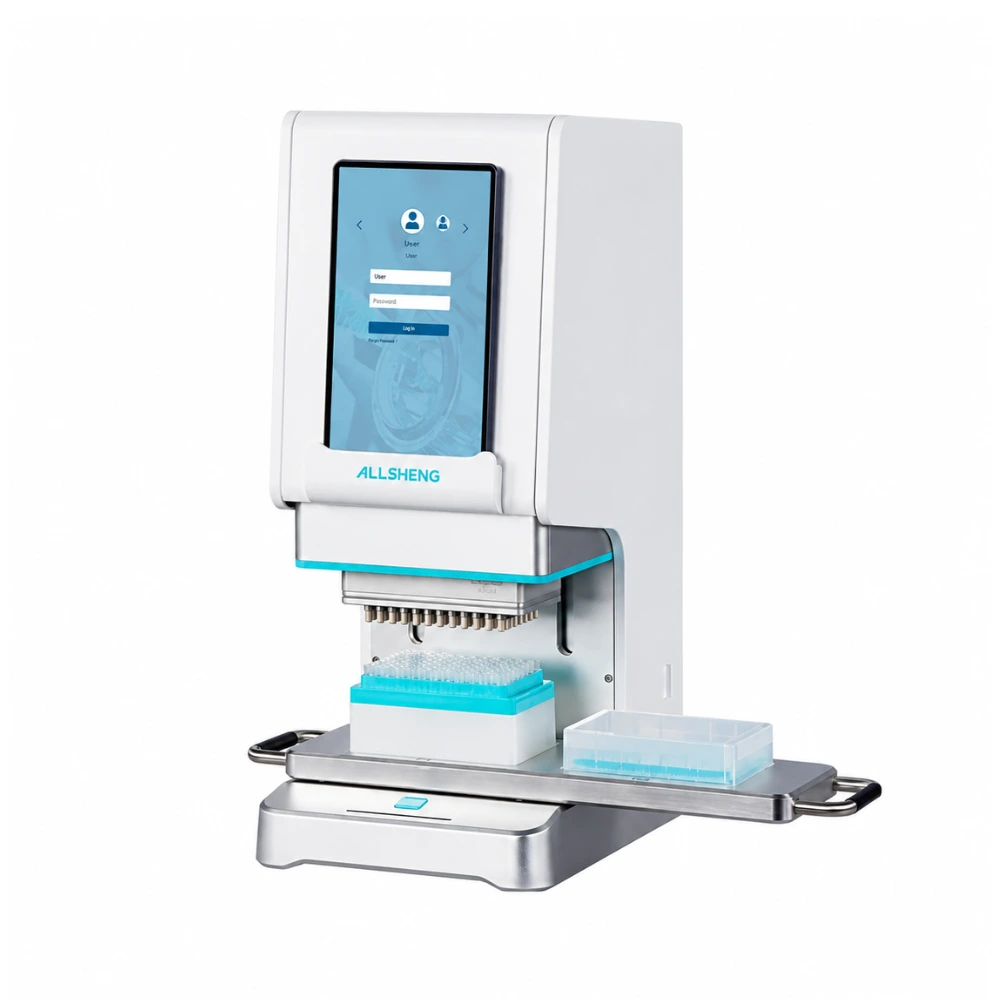
For example, the Allsheng Au-Mate 96 Series supports several automated functions:
- Liquid transfer: Move samples and reagents between microplates and reservoirs.
- Reagent dispensing: Distribute predetermined volumes across multiple wells.
- Serial dilution: Prepare concentration gradients for ELISA and compound screening.
- Sample mixing: Combine liquids through controlled aspiration and dispensing.
- Programmed workflows: Link multiple pipetting operations into repeatable procedures.
Consequently, laboratories can reduce repetitive pipetting while improving workflow consistency. Moreover, the system’s adjustable aspiration and dispensing speeds accommodate different liquid handling requirements.
Choosing the Right Liquid Handling Workstation
Before selecting an Automated Pipetting System, consider three important factors: pipetting volume, sample throughput and available plate positions.
The Allsheng Au-Mate 96 Series offers four configurations:
| Model | Plate Positions | Supported Pipetting Volumes |
| Au-Mate 96A2 | 2 | 1–200 µL |
| Au-Mate 96A4 | 4 | 1–200 µL |
| Au-Mate 96B2 | 2 | 1–1,000 µL |
| Au-Mate 96B4 | 4 | 1–1,000 µL |
Volume coverage requires the appropriate interchangeable pipetting heads.
For instance, PCR preparation typically requires smaller volumes, whereas cell culture applications may involve larger reagent transfers.
Additionally, laboratories performing complex Microplate Liquid Handling procedures may benefit from four plate positions. These accommodate additional source plates, destination plates or compatible consumables.The interchangeable 96-channel pipetting heads support efficient plate-based operations. However, laboratories should confirm pipetting accuracy at their intended working volumes.
Applications and Practical Considerations
A Liquid Handling Workstation supports Laboratory Automation across molecular biology, biotechnology and pharmaceutical research.
Typical applications include PCR/qPCR preparation, ELISA, DNA sequencing sample preparation, drug screening and selected cell culture procedures.
Unlike a fully integrated Liquid Handling Robot, a compact workstation focuses on programmable pipetting rather than extensive robotic integration.
Furthermore, the Au-Mate 96 Series supports compatible 24-, 96- and 384-well microplates. Its compact design also suits laboratories with limited bench space.Before purchasing, consider consumable compatibility, liquid properties and the number of steps required in your workflow.
Conclusion
Choosing a Liquid Handling Workstation starts with understanding your application rather than simply selecting the highest specification. As a Laboratory Supplier and Distributor in South Africa, Apex Scientific helps researchers select suitable Laboratory Equipment for their experimental requirements.
Explore our laboratory equipment range or learn more about the Allsheng Au-Mate 96 Series. For laboratory technology updates, connect with Apex Scientific on LinkedIn.