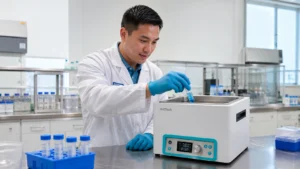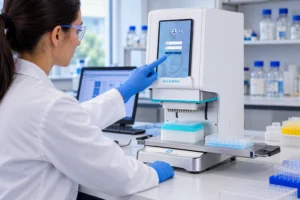
Accurate nucleic acid quantification is essential for reliable results in molecular biology, genetics, biotechnology, and clinical research. Whether preparing samples for quantitative PCR (qPCR), Next Generation Sequencing (NGS), or routine DNA analysis, researchers must determine nucleic acid concentrations before proceeding with downstream applications. Fluorometers provide a sensitive and selective method for measuring DNA, RNA, and other biological molecules using fluorescence-based assays.
Modern Fluorometers offer an effective alternative to conventional UV-Vis spectrophotometry, particularly when analysing low-concentration samples. By combining fluorescent dyes with sensitive optical detection, these instruments enable researchers to quantify nucleic acids while reducing interference from many common contaminants.For laboratories in South Africa, Allsheng offers the Fluo-200 and Fluo-800 Fluorometers, providing flexible solutions for individual measurements and higher-throughput sample analysis.
What is a Fluorometer and How Does It Work?
A Fluorometer is a laboratory instrument that measures fluorescence emitted by a sample after excitation with light at a specific wavelength. In molecular biology, researchers commonly use Fluorometers to determine DNA and RNA concentrations through specialised fluorescence quantification assays.
Unlike conventional spectrophotometers, which measure light absorption, Fluorometers detect light emitted by fluorescent molecules.
During nucleic acid quantification, researchers first combine a small volume of extracted DNA or RNA with a suitable fluorescent reagent. The dye interacts with the target nucleic acid, producing a fluorescence signal when illuminated at the appropriate excitation wavelength.
The instrument measures the emitted fluorescence and calculates the nucleic acid concentration using an assay-specific calibration.
This approach provides several advantages, including improved sensitivity at low concentrations and greater selectivity for particular nucleic acid types.However, accurate results depend on selecting compatible fluorescent dyes, following the appropriate assay protocol, and ensuring that sample concentrations fall within the assay’s validated measurement range.
Why is Fluorescence-Based DNA Quantification Important?
Accurate DNA Quantification plays an important role in molecular biology workflows. Researchers must frequently determine DNA concentrations before amplification, sequencing, cloning, or other analytical procedures.
Traditional UV-Vis spectrophotometers estimate nucleic acid concentrations by measuring absorbance at 260 nm. Although this technique offers rapid measurements, other substances that absorb ultraviolet light can influence the results.
For example, RNA contamination may contribute to the absorbance signal when measuring DNA. Consequently, spectrophotometric measurements may overestimate the concentration of the intended nucleic acid.
Fluorescence-based DNA Quantification addresses many of these limitations through selective fluorescent dyes.
A double-stranded DNA assay, for example, produces a fluorescence response associated with dsDNA. This helps researchers quantify their target material with reduced interference from other nucleic acid types, depending on the assay’s selectivity.
Furthermore, high-sensitivity fluorescence assays can measure DNA concentrations that are difficult to quantify reliably using conventional absorbance-based methods.These capabilities make Fluorometers particularly valuable when working with limited biological samples, low-yield extractions, and sensitive downstream applications.
Fluorometers in qPCR Sample Preparation
Quantitative PCR, commonly known as qPCR, allows researchers to monitor DNA amplification during a PCR reaction. Laboratories use this technique in gene expression studies, genetic analysis, pathogen research, and molecular diagnostics.
Before performing qPCR, researchers often need to determine the concentration of extracted nucleic acids.
Accurate DNA Quantification helps laboratories standardise sample input concentrations, particularly when comparing multiple samples or preparing consistent reaction mixtures.
For example, researchers extracting genomic DNA from cultured cells may use a Fluorometer to measure DNA concentration before preparing their qPCR reactions.
Similarly, researchers performing reverse transcription quantitative PCR (RT-qPCR) may quantify extracted RNA before converting it into complementary DNA (cDNA).
However, Fluorometers and qPCR instruments perform different functions. A Fluorometer measures nucleic acid concentration, whereas a qPCR system amplifies and detects specific nucleic acid sequences.Therefore, these instruments complement one another within a molecular biology workflow
The Role of Fluorometers in NGS Library Preparation
Next Generation Sequencing has transformed genomic research by allowing scientists to analyse large quantities of genetic information.
However, successful sequencing requires careful sample preparation and quality control. During NGS library preparation, researchers must quantify extracted DNA and prepared sequencing libraries to ensure that sufficient material is available for downstream processing.
Fluorometers provide a practical method for measuring DNA concentration at several stages of this workflow. For example, researchers may quantify genomic DNA immediately after extraction. They can then measure DNA concentration again following library preparation to assess the amount of material available for sequencing.
High-sensitivity dsDNA assays are particularly useful when working with low-concentration DNA samples. Nevertheless, fluorescence-based quantification measures DNA concentration rather than fragment length or library integrity.
Consequently, laboratories may also require a DNA fragment analyser to evaluate fragment size distribution. In some sequencing workflows, qPCR-based library quantification provides additional information about amplifiable library molecules.Together, these technologies support more comprehensive NGS library quality control.
Understanding High Sensitivity and Broad Range DNA Quantification Kits
Fluorometers require compatible fluorescence quantification reagents to measure nucleic acid concentrations.
The choice of assay depends primarily on the type of nucleic acid being measured and its expected concentration.Allsheng offers several DNA quantification kits for its Fluo Series Fluorometers.
High Sensitivity dsDNA Quantification Kits
High Sensitivity dsDNA assays are designed for measuring low concentrations of double-stranded DNA.
These assays are particularly useful for NGS library preparation, low-yield DNA extraction, and other applications involving limited quantities of DNA.For example, researchers extracting DNA from small tissue biopsies may require a high-sensitivity assay to quantify the recovered genetic material.
Broad Range dsDNA Quantification Kits
Broad Range dsDNA assays accommodate a wider concentration range, generally extending to higher DNA concentrations than high-sensitivity assays.
These kits are suitable for routine genomic DNA extraction, molecular biology research, and applications involving relatively concentrated DNA samples.For instance, laboratories extracting genomic DNA from bacterial cultures may use a Broad Range assay to determine DNA concentration before further analysis.
High Sensitivity ssDNA Quantification Kits
Single-stranded DNA assays are designed for measuring DNA molecules consisting of one nucleotide strand. Researchers may use these assays when working with synthetic oligonucleotides, specialised molecular biology experiments, or other applications involving ssDNA.
Importantly, the appropriate assay must match the sample type and expected concentration. Allsheng offers its High Sensitivity dsDNA, Broad Range dsDNA, and High Sensitivity ssDNA quantification kits in 100-, 200-, and 1,000-assay formats.
This allows laboratories to select reagent quantities according to their sample throughput and purchasing requirements.For RNA Quantification, laboratories should confirm the availability of a compatible RNA-specific fluorescence assay before selecting reagents.
How to Prepare Samples for Fluorescence Quantification
Fluorescence Quantification requires researchers to combine their extracted nucleic acids with an appropriate assay reagent before measurement. The procedure generally begins with nucleic acid extraction using a manual extraction kit or automated purification system.
Next, the researcher prepares a working solution containing the fluorescent dye and assay buffer. A small volume of extracted DNA or RNA is then added to the working solution.
After mixing and completing any required incubation, the researcher places the prepared sample into the Fluorometer. The instrument measures the fluorescence signal and calculates the nucleic acid concentration using the appropriate assay calibration.
Depending on the assay, researchers may also need to prepare calibration standards and account for the sample dilution factor.Importantly, the Fluorometer does not perform nucleic acid extraction. Instead, it measures the concentration of nucleic acids obtained from an earlier extraction or preparation step.
Allsheng Fluo-200 and Fluo-800 Fluorometers
Allsheng offers two Fluorometers designed to accommodate different laboratory throughput requirements.
The Fluo-200 provides a compact solution for laboratories performing individual sample measurements. In contrast, the Fluo-800 supports simultaneous measurement of up to eight samples.Both instruments feature dual-channel fluorescence detection, touchscreen operation, and support for compatible fluorescence reagents.
Allsheng Fluo-200 Fluorometer
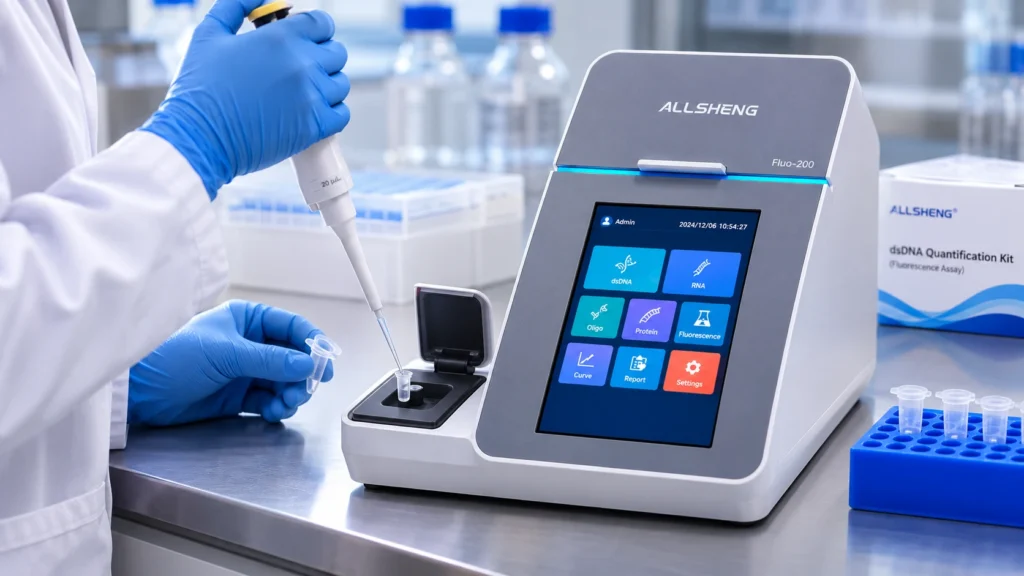
The Allsheng Fluo-200 is a single-sample Fluorometer designed for sensitive nucleic acid quantification.
Its optical system uses blue and red excitation channels, allowing researchers to work with compatible fluorescent dyes. The instrument provides measurement times of five seconds or less per sample and supports sample input volumes from 1 to 20 µL, depending on the assay.
Furthermore, its specified dsDNA high-sensitivity detection limit is below 0.1 pg/µL.
A 7-inch touchscreen provides access to instrument functions, while USB connectivity supports data export.The Fluo-200 is particularly suitable for research laboratories that require sensitive DNA Quantification without processing large sample batches.
Allsheng Fluo-800 Fluorometer
The Allsheng Fluo-800 is designed for laboratories requiring increased sample throughput. Unlike the single-sample Fluo-200, the Fluo-800 accommodates eight samples per measurement run. The instrument can measure eight prepared samples in six seconds or less, helping laboratories reduce measurement time when processing larger sample batches.
Additionally, the Fluo-800 features blue and red excitation channels, a 7-inch touchscreen, and USB connectivity for data export.
Its specified dsDNA high-sensitivity detection limit is below 1 pg/µL.The Fluo-800 is therefore well suited to laboratories performing routine nucleic acid quantification across multiple samples, including NGS preparation and molecular biology research.
Choosing Between the Fluo-200 and Fluo-800
Selecting the correct Fluorometer depends on several factors, including sample throughput, required sensitivity, assay compatibility, and laboratory workflow. Researchers processing individual samples may prefer the Fluo-200 because of its single-sample configuration and lower specified detection limit.
Alternatively, laboratories processing multiple samples per batch may benefit from the Fluo-800’s eight-sample measurement capacity. Both instruments support fluorescence-based nucleic acid quantification, although their sensitivity specifications and sample tube requirements differ.
Before selecting a model, laboratories should consider their expected sample concentrations, available sample volumes, and preferred fluorescence assay kits. Researchers should also establish whether their applications require DNA Quantification, RNA Quantification, or additional fluorescence-based measurements.These considerations help ensure that the selected instrument meets the laboratory’s analytical requirements.
Fluorometers and Nucleic Acid Purification Systems
Fluorometers form part of a broader molecular biology workflow that includes sample preparation, nucleic acid extraction, quantification, and downstream analysis.
For example, researchers may use an automated nucleic acid purification system to extract DNA from biological samples. Following extraction, a Fluorometer measures the concentration of the recovered DNA. The researcher can then prepare the quantified material for PCR, qPCR, sequencing, or other molecular biology applications.
Allsheng offers complementary technologies for these workflows, including automated nucleic acid purification systems, Fluorometers, DNA fragment analysers, and qPCR instruments.By combining these technologies, laboratories can establish more consistent sample preparation and quality control procedures.
Selecting Fluorometers for South African Laboratories
Fluorometers are valuable instruments for laboratories working in genetics, biotechnology, molecular biology, pharmaceutical research, and academic research.
When selecting an instrument, laboratories should evaluate measurement sensitivity, sample throughput, reagent compatibility, and data management requirements. Researchers should also consider the ongoing availability of fluorescence quantification kits and other consumables. The Allsheng Fluo-200 and Fluo-800 offer practical solutions for laboratories requiring sensitive DNA Quantification and flexible measurement capabilities.
Apex Scientific supplies laboratory equipment and consumables to research institutions, universities, and laboratories throughout South Africa.
Contact Apex Scientific to explore the Allsheng Fluorometer range and identify the appropriate instrument and fluorescence quantification kits for your laboratory applications.